Sulu:Touch 2026: What happened when we put Sulu’s future on the table
After Vienna and Amsterdam, we picked Dornbirn for this year's partner and community event. To be honest, we were nervous about it. Dornbirn is not a tech hub, it is not easy to reach, and asking people to travel into the Austrian Alps for a single day felt like a test of how much our community wanted to be in the same room.
A risk that paid off
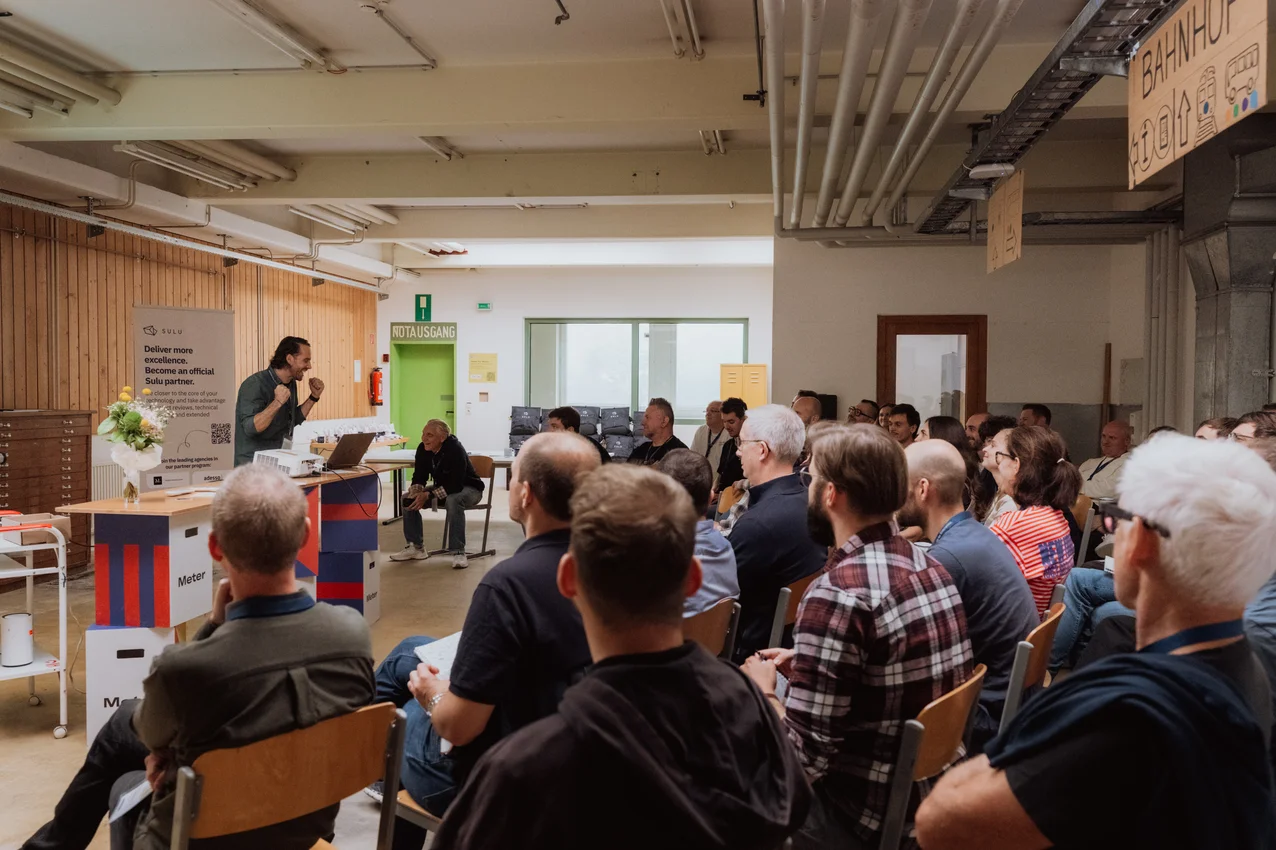
Nearly 50 people came. A few cancelled because of illness, and we had exactly one no-show. Anyone who has organised an event knows how rare that is. The turnout surprised us, but what stayed with us was how people showed up: prepared, curious, and ready to argue with us.
More than a technical event
We will not walk through the programme here. The biggest topic was the repositioning of Sulu as the open source DXP, and that post makes the full argument. In Dornbirn the question was a different one. Does the position hold up once the people who build with Sulu every day start poking at it?
The technical track with Alex, Johannes and Daniel was hands-on from the start: Sulu 3.1, the new Product Bundle, and what AI changes in a Sulu project. Practical sessions, lots of questions, people typing along.
The business track had fewer slides and more discussion. We put our thinking on the table, the enterprise offering, marketing and sales, the partner ecosystem, the business model behind an open source DXP, and asked for honest feedback. We got it. People challenged our assumptions and brought their own experience from customer projects into the room. Some of it was uncomfortable, all of it was useful.
That is what we had hoped for. The repositioning is more than a new message. It describes how we see Sulu's future, how we want to position ourselves in the market, and how we intend to build a sustainable business around an open source product. For our partners, this isn't just a change in how we describe Sulu. It changes which projects we want to win together, how we explain Sulu to customers, and what support agencies should expect from us. A position like that deserves to be tested by the people it affects most.
The difficult questions
The most valuable part of Sulu:Touch was not on the agenda. It was the conversations in between, over coffee, over a beer at the Angelika Kauffmann Museum, and late in the evening at the Hirschen restaurant in Schwarzenberg.
One thing stood out. Our community supports what we are building, and the same people are asking the hard questions. Can Sulu build a sustainable business without traditional software licensing? Can we keep Sulu fully open source while building a commercial offering around it? Can we compete with companies that have far more money than we do?
We don't have complete answers to all three. We think it is a sign of a healthy community that people ask them to our face instead of quietly moving on. A community that only applauds is not much use to anyone, least of all to us.
Competing without the same playbook
Many of our competitors have venture capital behind them, or marketing and sales budgets several times our size. Some days it feels like David versus Goliath. The temptation is to copy the playbook: raise money, hire a sales floor, buy visibility. We don't believe that is the right path for Sulu, and we are bootstrapped by choice.
Dornbirn strengthened our conviction that a product-led, open source approach can win. We believe we can compete on product quality and architecture, even without matching the budgets of larger vendors. And as AI-assisted development becomes part of everyday work, we see another advantage in building on an open codebase and a framework developers already know. The tools can read it, developers can trust it, and nothing is hidden behind a licence.
A great product alone is not enough, though. Our competitors can pay for reach. We can't, so we need another way to get it.
We believe the answer is a strong partner ecosystem: agencies, developers, businesses and contributors who believe in the product and benefit directly when it succeeds. The discussions about co-marketing, shared trade shows and what the Partner Program has to deliver were some of the most concrete of the day. Together, that network can create a reach we could never buy on our own. The goal isn't simply to extend our reach. It's to create opportunities together: better projects for partners, more expertise around Sulu, and a stronger platform for everyone building on it.
Scaling the product beyond the team
Behind all of this sits one idea that shapes how we run Sulu. Our goal isn't to build the biggest company. It's to build a product that can grow far beyond the size of our team.
We don't want to build the biggest organisation or hire hundreds of people to match larger vendors head on. We want a product that grows through its community, its partners, its contributors and its ecosystem, with a small team that keeps it coherent.
Open source makes that possible. It also demands a different approach to business, collaboration and long-term success, one where the value we create is shared widely enough that others have a reason to carry it further. Working that out is the real job of the next few years, and we are not pretending it is finished.
Not building this alone
Sulu:Touch in Dornbirn felt like the beginning of a new chapter. We shared our direction, challenged our own assumptions in public, received honest feedback, and saw how much our community cares about where Sulu goes next.
We left with more confidence in our strategy and a clearer view of the work ahead. Above all, we were reminded that we are not building this alone. That is the part we keep coming back to, and it is what makes the next chapter something we look forward to rather than something we worry about.
Thank you to everyone who made the trip into the Alps. If you were there and have thoughts you didn't get to share, or if you weren't and want to be part of the next one, we would like to hear from you on LinkedIn or GitHub.